It's Hip to be a Square
About the Exhibition
It's Hip to be a Square invites you to consider how one deceptively simple shape—the square—is used by artists to convey a range of interesting and profound ideas. Across centuries and cultures, squares have commanded attention, focused the eye and mind, and summoned a sense of order and purpose. Squares expressed divine harmony in medieval culture, while Renaissance-era artists and architects deployed the shape to assert a worldview grounded in balance and rationality. In modernity, the square became a site of conceptual inquiry. As one of the founding gestures of modern art, the Russian avant-garde painter Kazimir Malevich depicted a simple tilted square in his radical Black Square, with which he strove to "free art from the ballast of the objective [represented] world." Subsequent artists have used the square to explore spiritual ideals, visual perception, and serial logic. It's Hip to be a Square presents the works of artists who have advanced these ideas and phenomena. For example, Edna Andrade's rigorous grids explore the geometry of nature and the experience of looking. Larry Day's Neo-Renaissance architectural tableaux invest the streets of Philadelphia with a metaphysical framework. Moe Brooker's buoyant compositions reify the structure and temporality of musical performance, and Warren Rohrer's luminous color fields act as icons of the landscape of his native Lancaster County through the days and seasons.
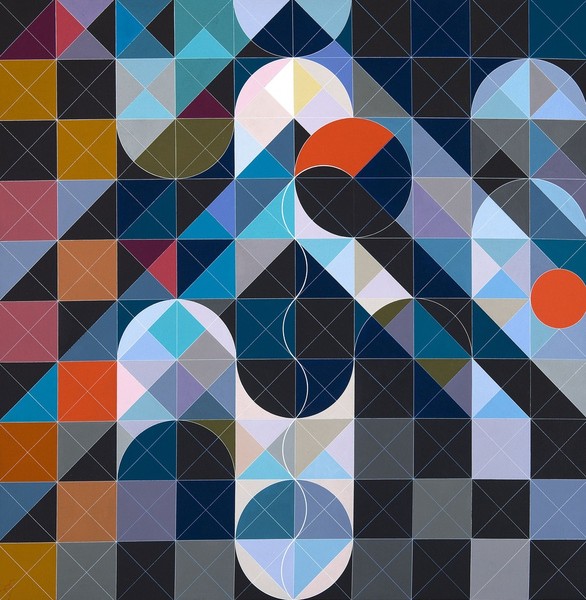
Edna Andrade, "Moonrise," 1983, Acrylic on canvas, 30 x 30 in. (Woodmere Art Museum: Gift of Donna Turner Petersen and Robert E. A. Petersen, 1995)
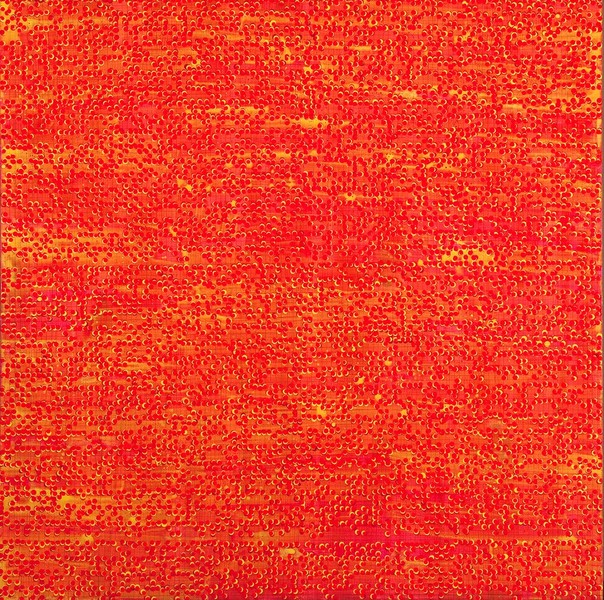
Juri Kim, "Melancholic Exception," 2010, Acrylic on canvas, 48 x 48 in. (Woodmere Art Museum: Gift of the artist, 2011)